 |
| Dunk the Clown, Peekskill, NY 2010 © Robert Forlini |
 |
| Calf Feeding, Rhinebeck, NY, 2008 © Robert Forlini |
|
| Dunk the Clown, Peekskill, NY 2010 © Robert Forlini |
|
| Calf Feeding, Rhinebeck, NY, 2008 © Robert Forlini |
 |
| Mother's Day, Lake Peekskill, NY 2004 ©Robert Forlini |

 |
| Qibao, Shanghai, 2007 ©Ying Tang |
 |
| A rickshawman taking a nap in Jama Masjid Market, Delhi, 2005 © Raghu Rai |
 |
| Midtown Shoppers, NYC, 2010 © Robert Forlini |
 |
| Mother's Day, Elmsford, NY 2010 © Robert Forlini |
 |
| Prize Winner, State Fair, Syracuse, NY, 2010 © Robert Forlini |
 |
| Three Musicians, 1978 © Paul McDonough |
For me, Paul McDonough is one of the unsung heros of photography. Although he has been creating images of keen observation and wit for many years, his work has remained largely under appreciated. Now, his second exhibition at Sasha Wolf Gallery in New York is accompanied by his first published book, hopefully bringing him more widespread notoriety in order to help correct this oversight. The exhibition entitled New York City, 1973-1978, together with the photographs from Paul's previous show at the gallery, comprise the work included in the monograph Paul McDonough: New York Photographs, 1968-1978 (Umbrage Editions, Fall 2010), which includes an essay by Museum of Modern Art curator Susan Kismaric. The book covers Paul's early work in photography when he was a new arrival in New York City. He was introduced to Garry Winogrand by childhood friend Tod Papageorge, and was soon inspired to switch from easel painting to street photography as a mode of expression. The pictures themselves not only capture the essence of the City during a time of turmoil and ferment, but have a timeless quality and irony found in spontaneous human drama. Paul has an eye for strange juxtapositions and split second coincidences which are simultaneously poignant and funny. His cast of characters include a encounter between a blind beggar and a hare krishna, three hungry car salesmen waiting for their next prey, a group of Japanese tourists at an exhibit of the first atomic bomb and a crazy collection of tree-climbing kids, bicycles and lovers (among others) in Central Park. The sum total effect of the work is bittersweet. Paul was a teacher of mine at Pratt Institute in the 1980's, and I remembered much of this work from exhibitions back then, an indiction of how well these photographs have endured the test of time. It was a pleasure to be able to experience them again, along with seeing the newly edited pictures for the first time. As Susan Kismaric concluded in her appreciation in the book, "In these pictures, working within a revered tradition so suitable for the pace of modern life, McDonough has applied his finely tuned intuition to show us nothing less than the poetry of daily life."
 |
| War Museum Display-West Point 1975 © Paul McDonough |
- The exhibition at Sasha Wolf Gallery runs through January 8, 2011. The gallery is located at 548 West 28th Street in the Chelsea section of Manhattan and is open Tuesday through Saturday 11am-6 pm. Phone 212-925-0025, e-mail info@sashawolf.com.
- The monograph, Paul McDonough: New York Photographs, 1968-1978, is available from amazon.com.
 |
| Central Park Pond-Kids in Tree 1973 © Paul McDonough |
 Please don't get me wrong: Lee Friedlander is one of our greatest photographers, and his work often amazes and delights me. But his latest dispatch, "America by Car", on view at the Whitney Museum of American Art through November 28, is a huge disappointment. Friedlander is still an acute observer of quirky American culture, but the newly added gimmick of photographing through the interior of a car using a Hasselblad Super Wide camera creates a formal distraction and a mitigating factor to accessing the pleasure and meaning of these pictures. The interiors are not that visually interesting in the first place, and become monotonous when repeated ad nauseam. I felt like yelling, "You've come this far, just get out of the car, Lee!" The most engaging parts of the pictures are out there, reduced to mere incidental details which would be better explored on foot. As John Szarkowski once observed, the secret to photography is standing in the right place, and sitting inside the automobile isn't it. Even Friedlander's other recent pictures taken with the Super Wide seem like a retread of his prior work, a deliberate reprise of the same subject matter through a lens that caricatures his previous accomplishments. Is the photographer getting lazy, or making a nod to Postmodernism? I am reminded of how much more successful were André Kertész's later Polaroid SX-70 photographs in their construction and pathos. Even though the photographer was limited by his age in his ability to move about, he managed to turn this apparent disadvantage around in order to create images that built upon his past achievements. I believe that this work ingeniously becomes an allegory for his earlier period. Every artist has his or her hits and misses, but what really surprises me is the widespread acclaim that has accompanied "America by Car". What has happened to critical judgement in photography writing? Is there an acceptance that the anointed can do no wrong, or is there too much at stake in the art game to risk tainting the reputation of an investment, if not an artist? I'm sorry to have to be the one to say it, but the emperor has no clothes. 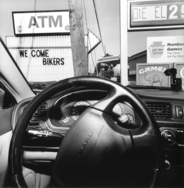  Top left of page: Alaska 2007 © Lee Friedlander Top right: Montana 2008 © Lee Friedlander Bottom left: January 1979 © Estate of André Kertész
|
 |
| Orange is back in style! |


 Posts
All Comments
Posts
All Comments


