Sunday, October 24, 2010

Lee Friedlander's "America by Car" at the Whitney Museum is a Disappointment

Please don't get me wrong: Lee Friedlander is one of our greatest photographers, and his work often amazes and delights me. But his latest dispatch, "America by Car", on view at the Whitney Museum of American Art through November 28, is a huge disappointment. Friedlander is still an acute observer of quirky American culture, but the newly added gimmick of photographing through the interior of a car using a Hasselblad Super Wide camera creates a formal distraction and a mitigating factor to accessing the pleasure and meaning of these pictures. The interiors are not that visually interesting in the first place, and become monotonous when repeated ad nauseam. I felt like yelling, "You've come this far, just get out of the car, Lee!" The most engaging parts of the pictures are out there, reduced to mere incidental details which would be better explored on foot. As John Szarkowski once observed, the secret to photography is standing in the right place, and sitting inside the automobile isn't it. Even Friedlander's other recent pictures taken with the Super Wide seem like a retread of his prior work, a deliberate reprise of the same subject matter through a lens that caricatures his previous accomplishments. Is the photographer getting lazy, or making a nod to Postmodernism? I am reminded of how much more successful were André Kertész's later Polaroid SX-70 photographs in their construction and pathos. Even though the photographer was limited by his age in his ability to move about, he managed to turn this apparent disadvantage around in order to create images that built upon his past achievements. I believe that this work ingeniously becomes an allegory for his earlier period. Every artist has his or her hits and misses, but what really surprises me is the widespread acclaim that has accompanied "America by Car". What has happened to critical judgement in photography writing? Is there an acceptance that the anointed can do no wrong, or is there too much at stake in the art game to risk tainting the reputation of an investment, if not an artist? I'm sorry to have to be the one to say it, but the emperor has no clothes.
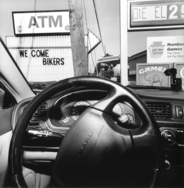
Top left of page: Alaska 2007 © Lee Friedlander
Top right: Montana 2008 © Lee Friedlander                                                                            
Bottom left: January 1979 © Estate of André Kertész

Thursday, September 30, 2010

Still Printing in the Darkroom? Try Adox Paper!

Orange is back in style!
When Agfa Photo went belly-up in 2005, I was devastated. The paper and other black and white photo materials which I had used for many years and which in part defined my style were no longer available. I went back to using Ilford materials, which I found to be adequate, but not up to Agfa's superior quality. Now the Adox company of Germany has revived many of Agfa's inimitable photo products, including variable and graded paper, film and chemistry. Adox bought the old Agfa manufacturing machines and claims the materials to be identical to the original. My experience bears this out. The superb quality, including the long tonal scale, deep, rich blacks and ability to produce more contrast (which can save many otherwise unprintable negatives) are all there! For me, a new day has dawned and my interest in silver printing has been renewed, even in this digital age. Both the RC and Fiber versions are outstanding. This is an unsolicited endorsement, and I encourage you to try this paper. I really want to keep this bold venture afloat so we don't lose this excellent product again. Also, if you were a fan of Agfa film and the famous Rodinal, now Adonal, developer (not my cup of developer, but I know many who swore by it), these have been reincarnated as well. Currently available in the USA only from Freestyle Photo. Many worldwide distributors can be found on the Adox website, along with technical data. Happy printing!

Tuesday, September 28, 2010

Why Study Art?

...and so he became an art teacher.
©1979 Mark Alan Stamaty
Autumn is here, and it's time for students and teachers alike to turn their thoughts back to the business of education. I sometimes hear the value of formally studying art debated. After all, art is a subjective thing and who's to say what's good or bad? True, we can teach technique and traditions, but can creativity be learned, or is it something innate? I once heard the photographer Roy DeCarava (who taught at Hunter College for many years) say that the best experience you can expect from an art teacher is "to be inspired, to get really turned around." I have been lucky to have had several teachers who influenced and informed my path as an artist. What has distinguished the best teachers has been their passion and commitment as artists, not only as educators but as practitioners of their craft. As Phil Perkis noted in Teaching Photography: Notes Assembled, "The teacher is seldom the person who loves science and runs home after school to the basement to do science experiments." But how much better to have a teacher who actually does what they teach! The best schools require this from their instructors, but incredible as it seems, many do not. I know an artist who enrolled in a university art education program to discover that many of her fellow students had never made art themselves, yet they would earn degrees declaring them "art educators". It's no wonder then that this lack of commitment leads to mediocre teaching in the arts, which further justifies fiscal cuts. I'm also tired of the perceived need to justify art in the schools because it improves test scores in other, more "academic" disciplines. Why shouldn't art be taught for it's own inherent value and the joy it brings? As Krishnamurti observed in Think on These Things, we should be teaching our students how to think rather than what to think. That's what studying art gives us.

Saturday, August 21, 2010

PHOTOcentric 2010 at Garrison Arts Center Sept.3-26; Reception Fri. Sept. 3, 6-9pm

Andrew Jackson's Tomb, Nashville, TN 2009
© Robert Forlini
I will be exhibiting two photos, Andrew Jackson's Tomb, Nashville, TN 2009 and Girls Fishing, Lake Peekskill, NY 2009 in this year's PHOTOcentric show at the Garrison Arts Center. The show was juried by eminent photographers Stephen Shore and Harvey Stein, and I am thrilled to be a part of it. The show runs from September 3-26, 2010, with an opening reception on Friday, September 3 from 6-8pm. The Garrison Arts Center is located at 23 Garrison's Landing in Garrison, NY 10524, about an hour drive from New York City and easily accessible by Metro-North Hudson Line trains from Grand Central Terminal. For further information, you may contact the gallery at 845-424-3960 or at info@garrisonartcenter.org. I hope you can make it!

Tuesday, August 17, 2010

Write Up on Hey Hot Shot! Blog

Lemonade Stand, Rhinebeck, NY 2009
© Robert Forlini
     First off, apologies to both of my followers for the dearth of posts lately. People often ask me if I have a Facebook or Twitter page. The answer is no for now. I have a hard enough time keeping up with this blog! One reason is that not that many interesting things happen to me. Another is that I'm probably spending too much time shooting on the street or laboring in my darkroom. Remember, I savor time away from my computer. I guess I still prefer reality to virtual reality.
     In other news, my photos just received a nice write up on the Hey Hot Shot! Blog. For those of you not familiar with it, HHS! is a photography competition project of the Jen Bekman Gallery in New York. Occasional contenders are selected to be featured on the site's blog, and mine was one of them. Shout out to Casey A. Gollan who wrote the piece, and who dug a little deeper into the archives of my web site to see beyond my original submission.
HHS! Contender: Robert Forlini

Thursday, May 27, 2010

Italian Feast Photos on Exhibit at Ciao Italy Festival in Brooklyn on June 19

Dancing of the Giglio, Brooklyn, NY, 1999 © Robert Forlini

I will be exhibiting a selection of photographs from my Italian-American Festival series at the 3rd Annual Ciao Italy Performing Arts Festival in Williamsburg, Brooklyn on Saturday June 19 from 6pm-10pm. Photographer Todd Carroll will also be showing his photographs of Italian folk dance festivals. The event will present a variety of performances of traditional Italian and Italian-inspired music, opera, dance and theater, and will be held at the Associazione San Cono, 233 Ainslie Street, Ground Floor, in the Williamsburg section of Brooklyn. The festival was conceived to create a bridge between the historic Italian community and the community of artists now living and working in the neighborhood. Cost of a festival pass is $25.00, and RSVP is strongly suggested at info@AnabellaLenzu.com or 347-338-8852. Special thanks and appreciation to Anabella Lenzu and Todd Carroll for organizing this event in the celebration Italian culture. The evening promises to be an exciting and entertaining experience for all. Ci vediamo alla festa!
Angels, Columbus Day Parade, NYC
1998 © Robert Forlini


Sunday, April 18, 2010

Henri Cartier-Bresson @MoMA

If you are in New York, do not pass GO, visit "Henri Cartier-Bresson: The Modern Century" at the Museum of Modern Art on view now through June 28. This extensive retrospective contains over 300 prints from the career of one of the true masters of the medium. The exhibition, curated by Peter Galassi, occupies the 6th floor galleries and is categorized into 13 themes. There are many of the familiar "greatest hits" as well as rarely seen surprises which put his body of work into new perspective. While I'm particularly fond of HCB's early work for its immediacy and artistic freedom, I saw the later pictures in a different context. Many of the better known "photojournalistic" pictures which were sometimes fettered by the constraints of creating imagery more accessible to the public are complimented by photographs which are grittier and edgier. I felt some, especially the photos taken in the United States and the USSR, were prescient of the work of the younger photographer Robert Frank in their probing and haunting qualities. Mr. Galassi's essay in the accompanying catalogue offers further insight into the milieu behind this astonishing work. I was able to attend the panel discussion "The Legacy of Henri Cartier-Bresson" moderated by Mr. Galassi with Magnum photographer Gilles Peress and art historian Jean-Francois Chevier. While the evening was somewhat unstructured and meandering, the lively discussion provided fascinating anecdotes about Cartier-Bresson's life and work.